

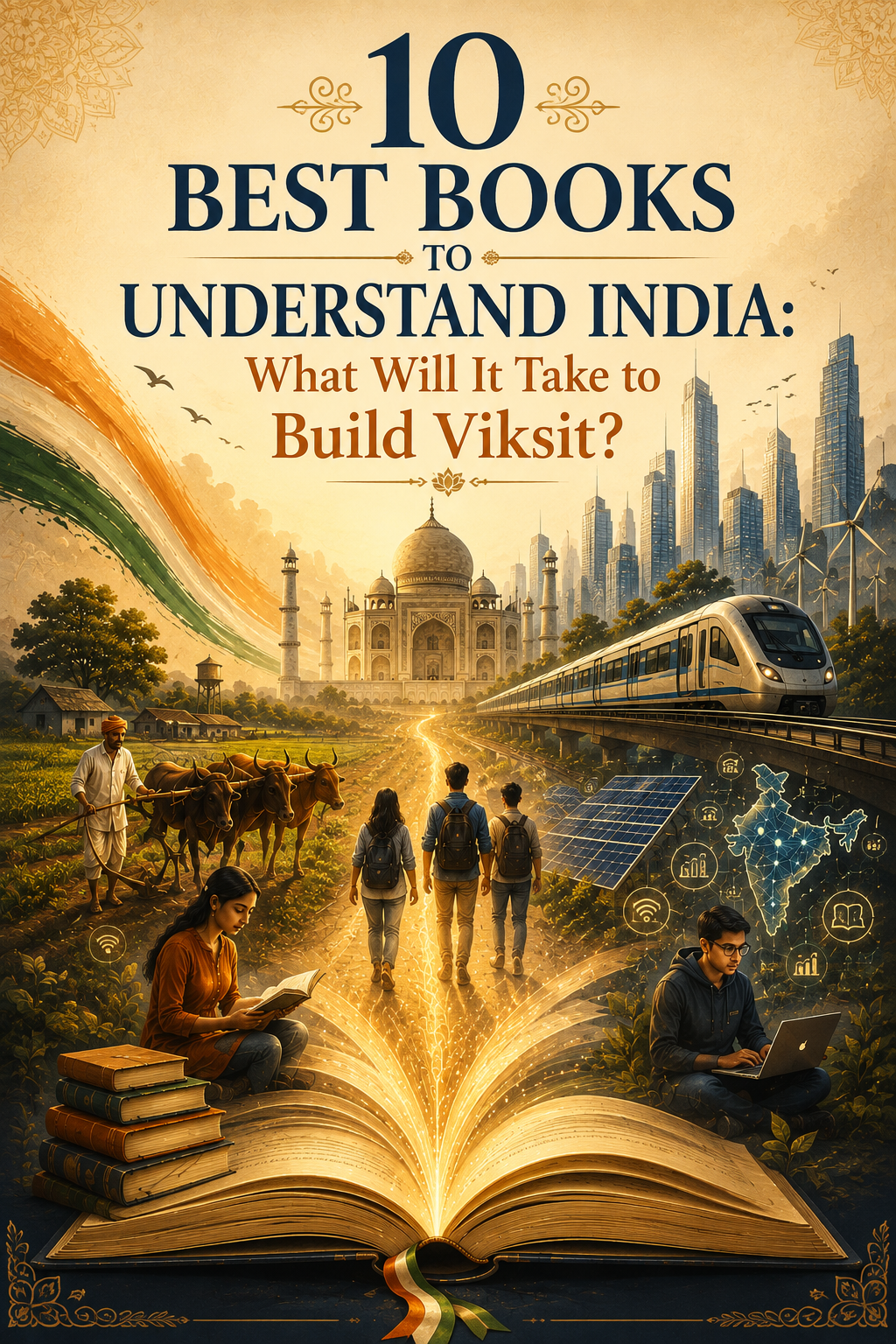
🇮🇳 Can books help us build a developed India?
India wants to become a Viksit Bharat by 2047, the centenary year of independence.
But here’s the question I find more interesting:
What does a developed India actually look like?
Is it simply a country with a larger GDP?
More highways?
More skyscrapers?
More billionaires?
More technology?
Or does a truly developed India also mean better schools, healthier citizens, productive jobs, stronger institutions, safer cities, less poverty, greater opportunity and a better quality of life?
The official Viksit Bharat @2047 vision itself goes beyond economic growth, encompassing social progress, environmental sustainability and good governance.
And that’s why I think books belong in this conversation.
Because a country’s development isn’t created by one budget, one government or one economic policy.
It is shaped by decades of decisions about people, institutions, education, business, democracy, technology, opportunity and society.
So I went looking for books that can help us understand those pieces.
Not books that simply praise India.
Not books that simply criticise India.
But books that make us think harder about the India we have and the India we want to build.
⚡ Quick Summary: The 10 Books
If you don’t want to read the entire article right now, here’s your reading map.
| Book | What it helps you understand | Viksit Bharat lesson |
|---|---|---|
| India After Gandhi | Modern India’s journey | Strong institutions & unity |
| India Unbound | India’s economic transformation | Markets, reforms & opportunity |
| Imagining India | India’s future | Infrastructure, technology & ideas |
| An Uncertain Glory | Human development | Growth must improve lives |
| Everybody Loves a Good Drought | Rural poverty | Development must reach the last mile |
| Whole Numbers and Half Truths | India’s data & society | Better decisions need better understanding |
| The Argumentative Indian | Democracy & pluralism | Debate is an asset, not a weakness |
| The Idea of India | India’s identity & democracy | Development needs a strong social foundation |
| The Billionaire Raj | Wealth & inequality | Growth needs opportunity and accountability |
| Development as Freedom | What development really means | Human freedom is the ultimate goal |
🧭 First, What Does “Viksit Bharat” Actually Mean?
Viksit Bharat @2047 is the stated vision of making India a developed nation by the 100th year of independence.
But the interesting part is that “development” isn’t one-dimensional.
It involves questions such as:
🇮🇳 Economy
How do we create wealth and productive jobs?
🎓 Education
How do we give India’s enormous young population useful skills?
🏥 Health
How do we create a healthier and more productive population?
🏭 Industry
How do we move towards higher productivity and manufacturing capability?
💻 Technology
How do we use AI, digital infrastructure and innovation?
🏙️ Cities
How do we build urban India without creating dysfunctional megacities?
🌾 Rural India
How do we make development reach villages and small towns?
⚖️ Institutions
How do we make government systems work better?
🌱 Environment
How do we grow without destroying the resources future Indians need?
🧑🤝🧑 Inclusion
How do we make sure development creates opportunity across society?
Recent government discussions around Viksit Bharat have explicitly highlighted areas including youth, skills, MSMEs, AI and inclusive human development.
And these ten books give us a fascinating way of thinking about almost all of them.
🇮🇳 Three Ways to Read India’s Development Story
| Lens | Question | Books |
|---|---|---|
| 📜 Where did we come from? | How did modern India emerge? | India After Gandhi |
| 💰 How did we change? | How did India’s economy transform? | India Unbound |
| 🚀 Where could we go? | What does India’s future require? | Imagining India |
| 🧑🤝🧑 Who gets left behind? | Is growth improving lives? | An Uncertain Glory |
| 🌾 Does growth reach Bharat? | What happens outside major cities? | Everybody Loves a Good Drought |
| 📊 What does the data say? | What does India actually look like? | Whole Numbers and Half Truths |
| 🏛️ How should India govern itself? | What makes institutions work? | The Argumentative Indian |
| 🇮🇳 What holds India together? | Identity, democracy and diversity | The Idea of India |
| 💎 Who benefits? | Wealth and inequality | The Billionaire Raj |
| 🕊️ What is development for? | Human freedom and capability | Development as Freedom |
1️⃣ India After Gandhi by Ramachandra Guha

🇮🇳 Why read this book?
If you want to understand modern India, this is one of the strongest places to begin.
India After Gandhi examines India’s journey after independence, including political conflicts, democracy, linguistic movements, social change and the many forces that have shaped the republic.
It is also one of the books repeatedly recommended as an important introduction to post-independence India.
🧠 What will you understand?
- Why India’s democracy survived when many expected it to struggle
- How linguistic and regional identities shaped the country
- How political institutions evolved
- Why India’s unity cannot be taken for granted
- How different parts of India developed differently
🚀 How can this book guide Viksit Bharat?
Before deciding where India should go, we need to understand how India got here.
A developed India cannot be built by ignoring its enormous diversity.
The lesson here is simple:
Economic development needs political and institutional stability.
Infrastructure can be built quickly.
Trust takes generations.
👀 Gen-Z takeaway
You can’t understand today’s India by starting with Instagram reels about today’s India.
Start with the story.
🛒 Buy the book
|
🇮🇳
Buy in India
Amazon India ↗
|
🌍
Buy Worldwide
Amazon Global ↗
|
Hardcover • Paperback • Kindle • Audible
2️⃣ India Unbound by Gurcharan Das

If India After Gandhi explains India’s political journey, India Unbound helps explain India’s economic journey.
Penguin describes it as the story of India’s rise from poverty towards prosperity and examines the clash of ideas around India’s economic transformation.
If you’re interested in money and economic behaviour, continue with our guide to Books Like The Psychology of Money.
💰 What will you understand?
- India’s pre-liberalisation economic model
- The significance of the 1991 reforms
- The rise of India’s private sector
- Entrepreneurship
- Globalisation
- The changing aspirations of Indians
🚀 How can this book guide Viksit Bharat?
A developed country needs productive economic activity.
That means:
🏭 Manufacturing
💻 Services
🚀 Entrepreneurship
🌏 Global trade
💡 Innovation
👷 Productive employment
The important lesson isn’t simply “markets are good.”
It is:
India needs an economic environment where people can create, invest, innovate and build.
👀 Gen-Z takeaway
The India your parents grew up in and the India you are entering the workforce in are economically very different countries.
This book helps explain why.
🛒 Buy the book
|
🇮🇳
Buy in India
Amazon India ↗
|
🌍
Buy Worldwide
Amazon Global ↗
|
Hardcover • Paperback • Kindle • Audible
3️⃣ Imagining India by Nandan Nilekani

This is perhaps the most directly relevant book in this list to the question of India’s future.
Penguin describes Imagining India as a perspective on India’s recent history and the core issues affecting its development, with Nilekani offering a blueprint for India in the twenty-first century.
💡 What will you understand?
The book explores major questions around:
- Infrastructure
- Education
- Technology
- Demographics
- Urbanisation
- Entrepreneurship
- India’s future
🚀 How can this book guide Viksit Bharat?
This book asks a question every developing country eventually has to answer:
How do we turn potential into productivity?
India has an enormous population.
But population alone isn’t an advantage.
People need:
🎓 Skills
💼 Jobs
💻 Technology
🏭 Industry
🚀 Entrepreneurship
👀 Gen-Z takeaway
India’s biggest competitive advantage may not be cheap labour.
It may be millions of young people who can create things the world wants.
🛒 Buy the book
|
🇮🇳
Buy in India
Amazon India ↗
|
🌍
Buy Worldwide
Amazon Global ↗
|
Hardcover • Paperback • Kindle • Audible
4️⃣ An Uncertain Glory by Jean Drèze & Amartya Sen

Here’s where the conversation becomes uncomfortable.
Can India become a developed country simply by growing its economy?
This book argues that rapid economic growth alone cannot solve India’s development problems, particularly when basic needs and inequalities remain.
🧠 What will you understand?
- Poverty
- Education
- Healthcare
- Gender inequality
- Public services
- Human development
- The relationship between growth and quality of life
🚀 How can this book guide Viksit Bharat?
Imagine India becoming much richer while millions still lack quality healthcare or education.
Would that be enough to call India developed?
That’s the question this book forces us to confront.
GDP is a means. Human well-being is the destination.
👀 Gen-Z takeaway
A country isn’t “developed” because its skyline looks futuristic.
It’s developed when ordinary people get better lives.
🛒 Buy the book
|
🇮🇳
Buy in India
Amazon India ↗
|
🌍
Buy Worldwide
Amazon Global ↗
|
Hardcover • Paperback • Kindle • Audible
5️⃣ Everybody Loves a Good Drought by P. Sainath

This is the book that takes you away from India’s boardrooms and into its villages.
Penguin calls it a classic work of reportage on rural poverty and development, based on extensive reporting from some of India’s poorest districts.
🌾 What will you understand?
- Rural poverty
- Agriculture
- Government programmes
- Development failures
- Inequality
- Grassroots realities
🚀 How can this book guide Viksit Bharat?
A developed India cannot be an India where development is concentrated in a handful of cities.
The real test is:
What happens to the person living far away from India’s economic centres?
That means Viksit Bharat has to include:
🌾 Farmers
👩🌾 Rural women
🏘️ Small towns
🏫 Rural schools
🏥 Rural healthcare
💧 Water
⚡ Reliable infrastructure
🇮🇳 Bonus
There is also a Hindi edition, Teesri Fasal, making this particularly interesting for Indian readers who prefer Hindi.
👀 Gen-Z takeaway
Before saying “India is growing fast”, ask:
Who is actually experiencing that growth?
🛒 Buy the book
|
🇮🇳
Buy in India
Amazon India ↗
|
🌍
Buy Worldwide
Amazon Global ↗
|
Hardcover • Paperback • Kindle • Audible
6️⃣ Whole Numbers and Half Truths by Rukmini S.

📊 Why this book is different
India produces an enormous amount of data.
But numbers without context can easily become headlines rather than understanding.
Whole Numbers and Half Truths uses data journalism to examine modern India across subjects including voting, income, urbanisation, health, marriage, work and social attitudes.
🧠 What will you understand?
- How Indians actually live
- Income and consumption
- Urbanisation
- Voting behaviour
- Health
- Social attitudes
- The limits of statistics
🚀 How can this book guide Viksit Bharat?
Good development needs good decisions.
Good decisions need good information.
And good information requires more than throwing a number onto a PowerPoint slide.
👀 Gen-Z takeaway
Don’t let a viral statistic do your thinking for you.
Read the data.
Then read the context.
🛒 Buy the book
|
🇮🇳
Buy in India
Amazon India ↗
|
🌍
Buy Worldwide
Amazon Global ↗
|
Hardcover • Paperback • Kindle • Audible
7️⃣ The Argumentative Indian by Amartya Sen

Here’s a slightly different ingredient in the Viksit Bharat recipe:
the ability to disagree.
Sen explores India’s long tradition of debate, argument, pluralism and diverse intellectual traditions. The publisher notes the book’s focus on how these traditions matter for democracy, inequality and social harmony.
🗣️ What will you understand?
- Indian intellectual traditions
- Democracy
- Pluralism
- Identity
- Social inequality
- Public debate
🚀 How can this book guide Viksit Bharat?
A developed country isn’t necessarily one where everyone agrees.
It is one where people can disagree productively.
Innovation itself requires questioning:
Why?
What if?
Is there a better way?
👀 Gen-Z takeaway
Being argumentative isn’t always a bug.
Sometimes it’s the operating system of a democracy.
🛒 Buy the book
|
🇮🇳
Buy in India
Amazon India ↗
|
🌍
Buy Worldwide
Amazon Global ↗
|
Hardcover • Paperback • Kindle • Audible
8️⃣ The Idea of India by Sunil Khilnani

What exactly does “India” mean?
A civilisation?
A democracy?
A nation?
A collection of cultures?
A modern economic power?
Khilnani explores the contradictions surrounding India’s political identity, democracy and economic development. Penguin highlights the book’s focus on India’s democracy, economic visions, diverse cities, village culture and political identity.
🧠 What will you understand?
- India’s political identity
- Democracy
- Economic development
- Diversity
- Modernisation
- The tension between tradition and modernity
🚀 How can this book guide Viksit Bharat?
India doesn’t have to choose between:
tradition OR modernity
It needs to figure out how to carry the best of both into the future.
👀 Gen-Z takeaway
Modern India doesn’t have to delete its past to build its future.
It needs to know what to keep and what to change.
🛒 Buy the book
|
🇮🇳
Buy in India
Amazon India ↗
|
🌍
Buy Worldwide
Amazon Global ↗
|
Hardcover • Paperback • Kindle • Audible
9️⃣ The Billionaire Raj by James Crabtree

Now let’s talk about one of the uncomfortable questions of development:
Who benefits from economic growth?
The Billionaire Raj examines India’s wealthy business class, inequality and the complicated relationship between wealth, politics and economic transformation. Penguin Random House describes it as a portrait of India’s new billionaire class and a radically unequal society.
💰 What will you understand?
- India’s billionaire class
- Wealth creation
- Inequality
- Business
- Economic reform
- The relationship between business and politics
🚀 How can this book guide Viksit Bharat?
A successful economy should create more opportunity, not merely more billionaires.
The bigger question is:
Can India create a system where millions of people have a realistic chance to improve their economic position?
That’s a much harder question.
And a much more important one.
👀 Gen-Z takeaway
Don’t just ask:
“How many billionaires does India have?”
Ask:
“How many people can realistically become wealthier?”
🛒 Buy the book
|
🇮🇳
Buy in India
Amazon India ↗
|
🌍
Buy Worldwide
Amazon Global ↗
|
Hardcover • Paperback • Kindle • Audible
🔟 Development as Freedom by Amartya Sen

I wanted the final book to answer the biggest question of the entire article:
What is development actually for?
Sen’s framework argues that development should be understood through human freedom and capability, rather than simply economic wealth. Oxford University Press describes the book as a framework linking development, social justice, human rights and institutions.
🧠 What will you understand?
- Poverty
- Freedom
- Education
- Health
- Democracy
- Economic opportunity
- Social opportunity
- Human capability
🚀 How can this book guide Viksit Bharat?
This may be the most important idea in the entire reading list:
The ultimate purpose of development is not to make statistics look impressive. It is to expand what people are actually able to do and become.
A young Indian should have the freedom to:
🎓 Get a good education
💼 Find productive work
🚀 Start a business
🏥 Access healthcare
🗣️ Participate in society
👩💻 Build a career
🏡 Live with dignity
That’s development with a human face.
👀 Gen-Z takeaway
The goal isn’t to live in a richer country.
The goal is to live a richer life.
🛒 Buy the book
|
🇮🇳
Buy in India
Amazon India ↗
|
🌍
Buy Worldwide
Amazon Global ↗
|
Hardcover • Paperback • Kindle • Audible
📊 The Ultimate Comparison: Which Book Should You Read?
| If you want to understand… | Start with… |
|---|---|
| 🇮🇳 Modern India | India After Gandhi |
| 💰 India’s economy | India Unbound |
| 🚀 India’s future | Imagining India |
| 👨👩👧 Human development | An Uncertain Glory |
| 🌾 Rural India | Everybody Loves a Good Drought |
| 📊 India’s data | Whole Numbers and Half Truths |
| 🗣️ Democracy & debate | The Argumentative Indian |
| 🏛️ India’s identity | The Idea of India |
| 💎 Wealth & inequality | The Billionaire Raj |
| 🧑🤝🧑 Meaning of development | Development as Freedom |
🧩 What These 10 Books Tell Us About Viksit Bharat
Here’s where the reading list becomes more than a list.
Taken together, these books suggest that India’s development challenge isn’t one giant problem.
It’s a 10-piece puzzle.
| Viksit Bharat challenge | Books that help explain it |
|---|---|
| 🏛️ Strong institutions | India After Gandhi, The Idea of India |
| 💰 Economic growth | India Unbound |
| 🚀 Innovation | Imagining India |
| 🎓 Human development | An Uncertain Glory, Development as Freedom |
| 🌾 Rural development | Everybody Loves a Good Drought |
| 📊 Better decision-making | Whole Numbers and Half Truths |
| 🗣️ Democracy | The Argumentative Indian |
| ⚖️ Inequality | The Billionaire Raj |
| 🇮🇳 National identity | The Idea of India |
| 👨👩👧 Human freedom | Development as Freedom |
🔥 The Big Question: Can India Become a Developed Country by 2047?
Yes, it is possible.
But these books also suggest that it won’t happen simply because India’s GDP becomes larger.
The harder challenge is building an India where:
💼 More people have productive jobs
🎓 Children receive genuinely useful education
🏥 Healthcare isn’t a luxury
🏭 Manufacturing becomes more productive
💻 Technology creates opportunity rather than simply replacing workers
🌾 Rural India participates in growth
🏙️ Cities become more liveable
🏛️ Institutions become more effective
🌱 Growth remains environmentally sustainable
🧑🤝🧑 Economic opportunity becomes broader
🗳️ Democracy remains capable of handling disagreement
The government’s current Viksit Bharat framing itself emphasises areas including economic growth, social progress, sustainability and good governance, while recent NITI Aayog discussions have focused on inclusive human development, youth, MSMEs and future-ready skills.
🧠 My Personal Reading Order
If I were starting this journey from zero, I wouldn’t read these ten randomly.
I’d follow this path:
📕 Stage 1: Understand India
1. India After Gandhi
↓
📗 Stage 2: Understand India’s economy
2. India Unbound
↓
📘 Stage 3: Imagine the future
3. Imagining India
↓
📙 Stage 4: Understand what development misses
4. An Uncertain Glory
↓
📕 Stage 5: Meet rural India
5. Everybody Loves a Good Drought
↓
📗 Stage 6: Look at the data
6. Whole Numbers and Half Truths
↓
📘 Stage 7: Understand democracy
7. The Argumentative Indian
↓
📙 Stage 8: Think about India’s identity
8. The Idea of India
↓
📕 Stage 9: Question inequality
9. The Billionaire Raj
↓
📗 Stage 10: Reconsider development
10. Development as Freedom
By the end, you’re not just reading about India.
You’re building a mental model of India.
⚡ Gen-Z Reading Challenge: Don’t Read All 10
Let’s make this practical.
If you’re a student, young professional or simply curious about India’s future, start with three.
🚀 The 3-book Viksit Bharat Starter Pack
1. Imagining India
For India’s future.
2. India Unbound
For India’s economy.
3. Development as Freedom
For what development should actually achieve.
That’s your Future + Economy + Human Development trilogy.
📚 Three books.
🧠 One big question:
What kind of country do we want to build?
📱 If You Only Have 30 Minutes
Don’t abandon the list because these books look intimidating.
Try this:
10 minutes
Read the introduction of Imagining India.
10 minutes
Read the opening of India Unbound.
10 minutes
Read the introduction to Development as Freedom.
Then ask yourself:
If India becomes dramatically richer by 2047, what else must change for me to actually feel that India has become developed?
That’s a surprisingly good conversation starter.
💬 5 Questions These Books Should Make Every Indian Ask
1️⃣ Is GDP enough to measure development?
2️⃣ What kind of jobs will India’s young population actually have?
3️⃣ Can India modernise without losing its diversity?
4️⃣ How do we make growth reach rural and poorer communities?
5️⃣ What should an ordinary Indian experience differently in a Viksit Bharat?
And here’s my favourite:
If India becomes a developed country, what will actually change in an ordinary family’s daily life?
That’s the question I’d keep at the centre of this entire debate.
🇮🇳 What Does Viksit Bharat Mean to Me as a Reader?
For me, the most interesting idea emerging from these books is that development isn’t a finish line.
It is a process.
A bigger economy matters.
Better infrastructure matters.
Technology matters.
But so do:
curiosity, education, dignity, opportunity, institutions, health, freedom and the ability to dream beyond one’s circumstances.
A developed India shouldn’t simply be a richer version of today’s India.
It should be an India where more Indians have the freedom and capability to build the life they want.
And perhaps that’s where books have a surprisingly important role.
Because before we build a better country, we need to imagine what “better” actually means.
🧭 EBW’s Reading Framework
At Eternal Bookish World, I don’t think the best book is necessarily the most famous book.
The better question is:
What are you trying to understand?
That’s why this list isn’t ranked simply from “best” to “worst.”
Each book answers a different question.
📖 Want history? Start with India After Gandhi.
💰 Want economics? Start with India Unbound.
🚀 Want India’s future? Start with Imagining India.
🌾 Want to understand rural India? Read Everybody Loves a Good Drought.
📊 Want to question the numbers? Read Whole Numbers and Half Truths.
🧑🤝🧑 Want to understand development itself? Read Development as Freedom.
That’s the philosophy behind this reading guide: don’t just collect books. Choose books that answer the question you are carrying.
🔍 How We Selected These 10 Books
For this guide, the selection wasn’t based simply on popularity.
We looked for books that collectively provide different lenses on India:
- 🇮🇳 History
- 💰 Economics
- 🚀 Innovation
- 🎓 Human development
- 🌾 Rural India
- 📊 Data
- 🏛️ Democracy
- 🧑🤝🧑 Society
- ⚖️ Inequality
- 🕊️ Human freedom
We also deliberately included books that don’t always agree with each other.
That’s important.
A useful reading list shouldn’t become a political echo chamber.
It should give you enough different perspectives to form your own opinion.
🏆 Our Final Ranking
| Rank | Book | Viksit Bharat relevance | EBW rating |
|---|---|---|---|
| 🥇 | Imagining India | Future & innovation | ⭐⭐⭐⭐⭐ |
| 🥈 | India Unbound | Economic transformation | ⭐⭐⭐⭐⭐ |
| 🥉 | Development as Freedom | Human development | ⭐⭐⭐⭐⭐ |
| 4 | India After Gandhi | Institutions & modern India | ⭐⭐⭐⭐⭐ |
| 5 | An Uncertain Glory | Social development | ⭐⭐⭐⭐⭐ |
| 6 | Everybody Loves a Good Drought | Rural development | ⭐⭐⭐⭐⭐ |
| 7 | The Argumentative Indian | Democracy & pluralism | ⭐⭐⭐⭐⭐ |
| 8 | Whole Numbers and Half Truths | Data & society | ⭐⭐⭐⭐⭐ |
| 9 | The Idea of India | Identity & democracy | ⭐⭐⭐⭐⭐ |
| 10 | The Billionaire Raj | Wealth & inequality | ⭐⭐⭐⭐☆ |
Important: This isn’t a literary quality ranking. It’s a ranking based on how useful each book is for understanding India’s development journey.
📚 Which Book Should You Read Based on Your Age/Interest?
| You are… | Start with |
|---|---|
| 🎓 Student | Imagining India |
| 💼 Young professional | India Unbound |
| 📊 Data nerd | Whole Numbers and Half Truths |
| 🏛️ Politics enthusiast | India After Gandhi |
| 🌾 Interested in rural India | Everybody Loves a Good Drought |
| 🚀 Entrepreneur | Imagining India |
| 🧠 Deep thinker | Development as Freedom |
| 🗣️ Democracy enthusiast | The Argumentative Indian |
| 💰 Interested in inequality | The Billionaire Raj |
| 🇮🇳 Want the broadest overview | India After Gandhi |
❓ Frequently Asked Questions
Some of the strongest starting points include India After Gandhi by Ramachandra Guha, India Unbound by Gurcharan Das, Imagining India by Nandan Nilekani, The Argumentative Indian by Amartya Sen and Development as Freedom by Amartya Sen.
There isn’t one definitive “Viksit Bharat book.” Instead, books such as Imagining India, India Unbound, An Uncertain Glory, Everybody Loves a Good Drought and Development as Freedom help readers understand different challenges involved in India’s development journey.
India After Gandhi is an excellent starting point because it provides a broad account of India’s post-independence journey. It is also frequently recommended as a major introduction to contemporary Indian history.
Start with India Unbound for India’s economic transformation. You can then read An Uncertain Glory for the human-development side and The Billionaire Raj for questions around wealth and inequality.
Imagining India is one of the strongest choices because it directly examines major issues surrounding India’s development and offers a future-oriented perspective on the country.
Books cannot provide a single blueprint for making India developed. What they can do is help us understand the history, economic choices, social challenges, institutions and human-development questions that shape India’s future.
📌 The Bottom Line
India becoming Viksit Bharat by 2047 is ultimately not just an economic question.
It is a question about people.
What kind of education will they receive?
What jobs will they do?
What cities will they live in?
How healthy will they be?
How much freedom will they have?
How fairly will opportunity be distributed?
How effectively will institutions work?
And perhaps most importantly:
Will development make ordinary Indians feel that their lives have genuinely become better?
These ten books won’t give you one answer.
That’s precisely why I recommend reading them.
Because a country as complicated as India deserves more than one story.
It deserves a bookshelf. 🇮🇳📚
📚 Start Your Viksit Bharat Reading Journey
Start with these three:
🥇 Imagining India → Where could India go?
🥈 India Unbound → How did India’s economy change?
🥉 Development as Freedom → What should development actually achieve?
Then keep going.
Because Viksit Bharat isn’t only something governments build.
It is something citizens imagine, question, create and participate in.
✍️ About This Guide
Written & curated by Brijesh / Eternal Bookish World
At Eternal Bookish World, we read books not simply to rate them, but to help readers decide what to read next and why.
For this guide, we selected books across history, economics, development, democracy, society, inequality, technology and human development rather than relying only on bestseller lists.
Each book was evaluated on:
- 📚 relevance to understanding India
- 🇮🇳 relevance to India’s development journey
- 🧠 depth of ideas
- 👥 relevance to ordinary Indian lives
- 🚀 usefulness for thinking about Viksit Bharat
- 📖 accessibility for general readers
Research approach:
Book descriptions, publication details and factual claims were checked against publisher pages, established book databases and authoritative sources. The selection and rankings are editorial judgments by Eternal Bookish World.
📚 Continue Your India Reading Journey
If you enjoyed exploring these books on India, you may also like these Eternal Bookish World Reader Decision Guides:
📖 [Best Soulful Indian Reads]
Explore Indian books that connect with identity, culture, emotions, spirituality and the many layers of Indian life.
💼 [Best Books for People Starting Their First Job]
Starting your career? These books can help you navigate money, work, ambition and the transition into professional life.
💰 [Books Like The Psychology of Money]
Want to understand money, wealth and financial behaviour better? Explore books that can change the way you think about money.
❤️ [Liked Gunahon Ka Devta? Try These Indian Writers]
If Hindi literature and emotionally powerful Indian storytelling are your thing, discover more Indian authors and books worth reading.
🧠 [Best Self-Help Books for 2026]
Looking for books that can help you think better, build better habits and navigate modern life?
📚 [Best Books for Beginner Readers]
Not sure where to start your reading journey? Here’s our curated guide to books that are accessible, engaging and worth your time.
Gunahon Ka Devta पसंद आई? अब इन भारतीय लेखकों को ज़रूर पढ़ें
10 Books Every Young Indian Should Read If the Jantar Mantar Protests Made You Think
Find Your Perfect Book Based on Your Personality: 15 Books You’ll Love (2026 Guide)
The Ultimate Mythology Books Guide (2026)
11 Best Books for People Starting Their First Job (2026 Edition)
Books Like The Psychology of Money: 10 Must-Reads on Wealth, Behavior & Decision Making (2026)
10 Best Books Like The Alchemist That Will Change The Way You Think
🇮🇳 More Books to Understand India
If you’re building your own India bookshelf, don’t stop with these 10.
At Eternal Bookish World, we’re building a growing collection of Reader Decision Guides to help you find the right book based on what you want to understand, feel or explore next.
Leave a Reply